The War Diary of Jane Doner tells the story of “a 17-year-old high school senior, born in Cebu City and living there on December 8, 1941 . . . She fled from her home and hid in the jungle during the early days of the war but was betrayed and forced to surrender to the Imperial Japanese Military. Thereafter, Jane was interned in four prison camps before her eventual rescue and liberation in 1945 by the armed forces of the United States. During captivity she endured fear, starvation, disease and the death of many of her friends, but survived to tell the story.” Published in May 2021, the book can be purchased through Lulu press.
 In January 2021, Joe Huber published Rescue Raids of Luzon!, which chronicles the liberation of the civilian and POW camps. Here is the publisher’s description: “Between January 26th and February 23rd of 1945 on Luzon in the Philippines, America made its greatest rescue of civilians and military prisoners from deep behind enemy lines . . . This book summarizes these raids and describes the prison camp experience of the author and his family [who were first interned on Mindanao]. Photos, drawings, and old documents help tell the tale. In the largest raid on the prison at Santo Tomás in Manila, his family had “ringside seats . . .”
The book includes numerous family photos and diagrams of the camps and is available on a variety of sources including Amazon and authorHouse.
 According to the publisher’s writeup, War and Resistance in the Philippines, 1942-1944, published March, 2021, “repairs the fragmentary and incomplete historiography of the events in the Philippine Islands between the surrender of Allied forces in May 1942 and MacArthur’s return in October 1944. Chronicles by politicians and guerrilla leaders reflect limited points of view and personal and political agendas. No academic study has comprehensively examined the Filipino resistance with a critical interdisciplinary approach. As a result, this book provides the first coherent narrative of the protracted fighting by 260,000 guerrillas in 277 units across the archipelago.” Book includes index and bibliography.
James Kelly Morningstar is a retired U.S. Army armor officer and decorated combat veteran with degrees from West Point and Kansas State University, a master’s degree from Georgetown University, and a PhD from the University of Maryland. He currently teaches military history at Georgetown. He is the author of Patton’s War: A Radical Theory of War.
 Francis C. Gray is a retired bishop in the Episcopal Church and has served in congregations and dioceses in Florida, Indiana and Virginia. He was born in the Philippine Islands in 1940, where his parents were missionaries, and had a lifelong commitment to world mission. He was interned, with his parents, at Camp Holmes, Baguio, in 1942. The photo on the cover of For Thou Art With Me shows the Gray family, after liberation from Old Bilibid Prison. The book is based on the diaries of his father and was published in 2010.
It can be ordered directly from the author for $13, which includes postage. You can contact him directly at Karenandfrank@comcast.net.
 Frank Gray also published a small book of poetry in 2020 titled Released. A few of the titles are:
Prison Food
Death Warrant
Homecoming
The Sacrament of SPAM
This book can also be ordered directly from the author for $13, which includes postage. You can contact him at Karenandfrank@comcast.net.
 “Covering both the strategic and tactical aspects of the campaign through the participation of its soldiers, sailors, and airmen, as well as its commanders, James P. Duffy leads readers through a vivid account of the nearly year-long, bloody campaign to defeat over a quarter million die-hard Japanese defenders in the Pacific theater. Return to Victory: MacArthur’s Epic Liberation of the Philippines, is a wide-ranging, dramatic and stirring account of MacArthur’s epic liberation of the Philippines.” Published in March 2021, the book includes maps, photos, an index and bibliography. However, it has little information about the civilian camps.
 Interrupted Lives is a short book with perspectives by four American women who were interned in the civilian camps: Margaret Sams, Jane Stoll Wills, Sascha Jean Jansen and Karen Kerns Lewis.
Last printed in 2018, it is an excellent introduction to the struggle for everyday life in the camps during the War. The book includes several photos and illustrations.
Margaret Sams also wrote Forbidden Family: Wartime Memoir of the Philippines, 1941-1945.
 Amazing Grace: The Unbroken Spirit of a Japanese Prisoner of War, was published in 2015. “In early 1942, Grace Brown was taken a prisoner of the Japanese in the Philippines along with her husband Caldwell and their three-month-old son Iain [first on Cebu and later at STIC]. Their ordeal lasted three and a half years during which time they were starved and at the mercy of their captors.
For most of that time, Grace had to care for her son alone after Caldwell was taken from camp by the Japanese. She endured the next two years not knowing if her husband was alive or dead.
At her lowest point, Grace started keeping a secret diary, which she hid in her son’s teddy bear. Finally, back at home in Scotland, she wrote this dramatic account of all they had been through, which is being published for the first time to mark the 70th anniversary of VJ Day.” Son, Iain A. C. Brown reports that the book is available in Kindle format on Amazon.com. You can also contact Iain at brown@carlton-brown.eu.
Disclaimer: The inclusion of any titles in this list are intended to benefit the interests of our readers and do not imply any endorsement.
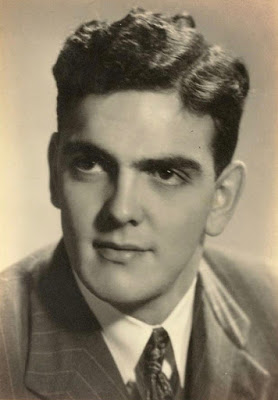
 A long-forgotten name from out of the dim and distant past suddenly came to my attention recently as I was looking through a “Maurice Francis Archives” post of 30 January 2022. It concerned an individual named William Sidney Nabors, who in World War II (WWII) was a civilian prisoner of the Nipponese for 37 months in Manila’s Santo Tomas Internment Camp (STIC). The significance of Nabors is the fact that his assumed name — which he used when he performed as a professional wrestler — was Danny Dusek (pictured at left). Now, while I did not know Nabors, in STIC or elsewhere, I was aware of the name and occupation of Danny Dusek, for he was well-known in the U.S. and the Philippines before WWII. He must have been well-known, as even I had heard of him, although I was not interested in sports at the time and was just 11 years old when I was welcomed into STIC. Probably I knew of Dusek because I was (and still am) a habitual listener to radio, and possibly also because of mentions by my father, who was interested in wrestling and especially boxing (he once took me along to see Jack Dempsey’s arrival at the Manila airport); and publicity surrounding Dusek’s arrival in the Philippines in 1941 undoubtedly was a major factor. [Note: for present purposes, pro wrestling is treated as a legitimate sport.]